
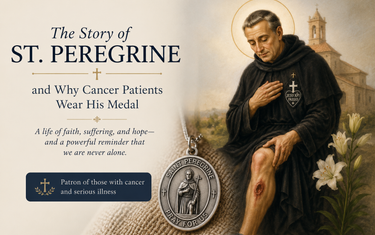
In the Italian town of Forlì, in the closing decades of the 1200s, a young man with a violent streak struck a priest across the face during a political dispute. That young man was Peregrine Laziosi. By the end of his life he would be known as one of the gentlest figures in the Catholic calendar, and centuries later his name would be whispered in hospital rooms and oncology wards across the world. The distance between those two moments is the whole reason cancer patients wear his medal today.
From rebel to friar
Peregrine was born into a well-off family in Forlì in 1260, in a time when his city was bitterly opposed to the authority of the Pope. As a young man he threw himself into that opposition. The story goes that during one confrontation he struck St. Philip Benizi, a priest who had come to preach peace. Rather than retaliate, Philip simply turned the other cheek.
Something in that gesture undid Peregrine. He repented, sought out the man he had wronged, and underwent a complete change of heart. He eventually joined the Servite Order and devoted the rest of his life to prayer, penance, and the care of the poor and the sick. He became especially known for one quiet discipline: he reportedly stood whenever it was not necessary to sit, for years on end, as a small constant offering.
The night before the amputation
It was that habit of standing, some accounts suggest, that contributed to the affliction that made him famous. In his later years Peregrine developed a cancer in his right leg. The disease advanced until the wound was so severe, and the prognosis so grave, that the physicians determined the leg would have to be amputated.
On the night before the surgery, Peregrine made his way to the chapter room of his monastery, where a crucifix hung on the wall. He spent the night in prayer before it, asking for healing if it was God's will. At some point he fell asleep and, in a dream or a vision, saw Christ descend from the cross and touch his diseased leg.
When the surgeon arrived the next morning to perform the amputation, the cancer was gone. There was no trace of the disease. Peregrine went on to live to the age of eighty. He was canonized in 1726, and his feast day is kept on May 1 — a date that, fittingly, now falls within the month many countries dedicate to cancer awareness and research.
Why his medal means what it means
It would be easy to misunderstand a St. Peregrine medal as a kind of good-luck charm against illness. It is something quite different, and more durable.
In Catholic understanding, a medal is a sacramental — not an object with power of its own, but a tangible reminder that draws the heart toward prayer and toward the communion of saints. To wear a St. Peregrine medal is not to believe the silver will heal you. It is to keep close the memory of a man who faced the exact fear you are facing — the diagnosis, the failing body, the surgery on the calendar — and who is now believed to intercede in heaven for everyone who carries that same burden.
That is why these medals are found where they are found: clipped to hospital gowns, tucked into the pockets of chemotherapy patients, set on the bedside tables of people too tired to do anything but hold them. They are worn not as a guarantee, but as a companion. They say: someone who understands is praying for me, and I am not walking through this alone.
A devotion that endures
Nearly seven hundred years after his death, St. Peregrine remains one of the most requested patron saints in the Catholic world, precisely because cancer remains one of the most universal fears. His story offers something that statistics and prognoses cannot: the witness of a person who stood at the very edge of that fear and found, against all expectation, that healing was possible and that God had not forgotten him.
Whether you are facing illness yourself, accompanying someone you love through treatment, or wishing to give a gift that carries real meaning, a St. Peregrine medal connects the person who wears it to that long line of hope.
Explore our full collection of St. Peregrine medals, handcrafted in the USA by Bliss Manufacturing and backed by a lifetime guarantee. You can also browse all our patron saint medals for cancer and illness to find the devotion that fits your need.
